
Kia Seltos: Air bag - advanced Supplemental Restraint System / Why didn't my air bag go off in a collision? (Inflation and non-inflation conditions of the air bag)
Contents:
There are many types of accidents in which the air bag system in the Kia Seltos may not be expected to provide additional protection. Air bags are designed to deploy only under specific collision conditions, depending on impact direction, force, sensor input, and vehicle movement.
Examples include rear impacts, second or third impacts in multiple-collision accidents, and many low-speed impacts where the seat belts may provide sufficient protection without air bag deployment.
Air bag inflation conditions
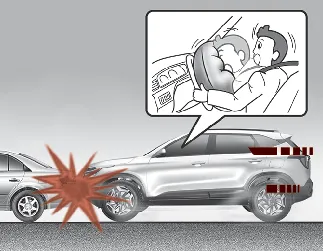
Front air bags
Front air bags in the Kia Seltos may inflate during a frontal collision depending on several factors, including the severity, direction, and force of the front impact.
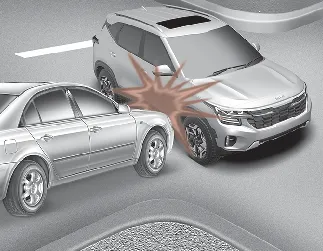
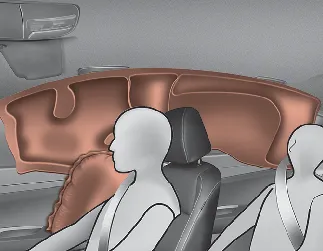
Side and/or curtain air bags
* The actual air bags in your Kia Seltos may differ from the illustration depending on model, trim, and equipment.
Side and/or curtain air bags may inflate when the side collision sensors detect an impact of sufficient severity. The exact operation depends on crash force, impact angle, and the location of the collision.
The side and curtain air bags are also designed to inflate when a rollover is detected by the rollover sensor.
Although the driver's and front passenger's front air bags are mainly designed for frontal collisions, they may inflate in other types of crashes if the front impact sensors detect enough frontal force.
Similarly, although side and curtain air bags are designed for certain side impacts, they may inflate in other situations where the sensors detect a strong side force. For example, side and/or curtain air bags may deploy if the system detects a possible rollover, even if a rollover does not actually occur, or if the Kia Seltos is tilted while being towed.
Even when side and/or curtain air bags do not provide direct impact protection in a rollover, they may still deploy to help reduce the risk of occupant ejection, especially when occupants are properly restrained with seat belts.
If the vehicle chassis is struck by bumps, rocks, curbs, or objects on rough roads, the air bags may deploy unexpectedly. Drive carefully on unimproved roads or surfaces not intended for normal vehicle traffic.
Air bag non-inflation conditions
-
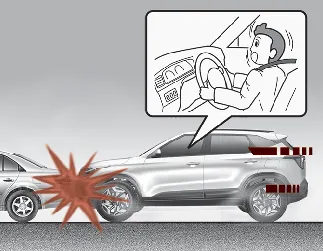
Air bags may not deploy in certain low-speed collisions where deployment would not add meaningful protection beyond the seat belts.
-
Air bags are not designed to inflate in rear collisions because occupants are generally moved backward by the force of impact. In this situation, inflated front air bags would not provide additional protection.
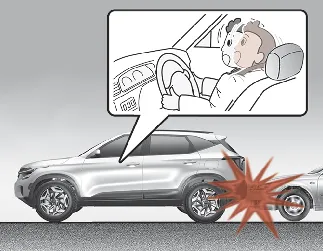
-
Front air bags may not inflate in side-impact collisions because occupants move toward the side of the impact. In these cases, front air bag deployment may not provide added protection.
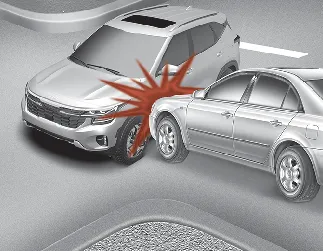
-
In an angled collision, the force of impact may move occupants in a direction where the air bags cannot provide additional benefit, and the sensors may not command deployment.
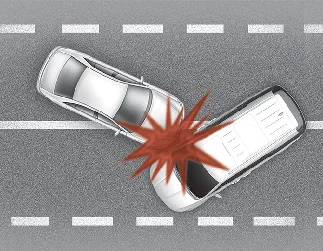
-
Just before impact, heavy braking may lower the front of the Kia Seltos, causing it to ride under a vehicle with higher ground clearance. In this under-ride situation, the deceleration forces detected by the sensors may be reduced, and the air bags may not inflate.
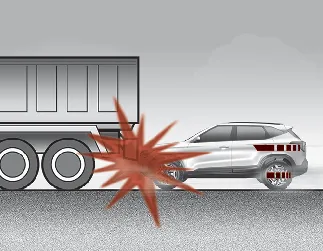
-
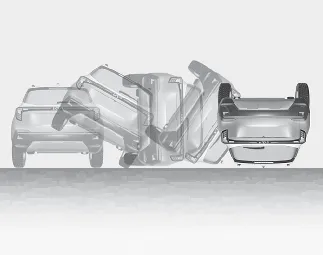
Front air bags may not inflate in all rollover accidents if the SRS control module determines that front air bag deployment would not provide additional occupant protection.
-
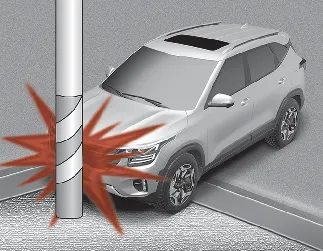
Air bags may not inflate if the Kia Seltos collides with a narrow object such as a utility pole or tree. In this type of crash, the impact force is concentrated in one area and may not be fully transmitted to the sensors.
Air bag deployment can be complex, and non-deployment does not always mean the system failed. The Kia Seltos Supplemental Restraint System evaluates the crash conditions and deploys air bags only when the system determines that deployment is necessary for occupant protection.


Other information:
Kia Seltos SP2 (2021-2026) Owner's Manual: AWD mode
AWD mode helps improve the driving performance of the Kia Seltos by controlling power delivery to all four wheels. This system supports better traction and stability when road conditions change, especially on wet, slippery, sandy, muddy, or uneven surfaces. You can switch from AWD AUTO mode to AWD Lock mode by pressing the AWD Lock mode switch.Kia Seltos SP2 (2021-2026) Owner's Manual: Intelligent variable transmission (IVT)
The Intelligent Variable Transmission (IVT) in the Kia Seltos adjusts automatically according to vehicle speed, accelerator pedal input, engine load, and the selected shift lever position. Instead of requiring the driver to choose individual gears manually during normal driving, the IVT is designed to provide smooth acceleration, efficient power delivery, and comfortable everyday operation.