| Engine Coolant Refilling And Air Bleeding |
|
•
|
Do not remove the pressure cap when the engine is hot.
|
|
•
|
Serious scalding could be caused by hot coolant under high pressure escaping from the reservoir
tank.
|
|
|
•
|
Be sure to add coolant according to the ITM coolant refill method.
|
|
•
|
When replenishing coolant, be careful not to spill on the belt, electrical devices.
|
|
By using the KDS, replace coolant and bleed air out.
| 1. |
Make sure the engine and radiator are cool to the touch.
|
| 2. |
Remove the pressure cap (A).
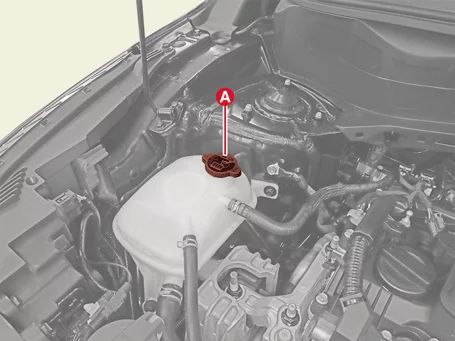
|
| 3. |
Remove the engine room under cover.
(Refer to Engine and Transaxle Assembly - "Engine Room Under
Cover")
|
| 4. |
Remove the drain plug (A) and drain the coolant.
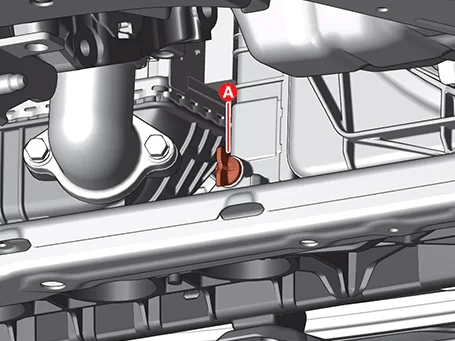
|
| 5. |
After draining the coolant, re-tighten the drain plug.
|
| 6. |
Drain coolant and inside the reservoir tank, and then clean it.
|
| 7. |
Fill mixture of the antifreeze and water (45 - 60%) as much as possible through the reservoir tank inlet
while IG-OFF.
Coolant capacity : Approximately 7.0 â„“ (1.85 U.S gal,
7.396 U.S.qt., 6.15914 Imp.qt.)
|
|
•
|
Press the radiator upper/lower hoses to allow air to escape easily.
|
|
•
|
For best cooling performance, use a antifreeze that meets vehicle specifications.
Genuine antifreeze is an antifreeze whose quality and performance are guaranteed by Kia.
|
|
•
|
Do not mix antifreeze/coolant from different brands.
|
|
•
|
Do not add any anti-rust.
|
|
•
|
Use only distilled water when mixing antifreeze with water.
|
|
•
|
If the concentration of coolant is less than 45%, corrosion or freezing may occur, and if
the concentration of coolant is more than 60%, the cooling effect may be reduced, so the
concentration of coolant shall be maintained at 50 to 55%.
|
|
|
| 8. |
Connect KDS in IG-ON state.
|
| 9. |
Perform the Integrated Thermal Management Module (ITM) coolant filling mode" using KDS.
|
Refer to the KDS screen for operating conditions and details
|
|
| 11. |
Fill the reservoir tank with coolant.
|
When the coolant temperature reaches 90°C (194° F) or 20 minutes have passed since the engine
start, check the coolant level in the reservoir tank and replenish.
|
|
| 12. |
Stop the Integrated Thermal Management Module (ITM) cooling water filling mode" using KDS.
|
| 13. |
Run the engine until enough coolant circulates.
|
| 14. |
Check the Coolant capacity in the reservoir tank, refill it to the "MAX" (or "FULL") line.
|
| 15. |
Install the engine room under cover.
(Refer to Engine and Transaxle Assembly - "Engine Room Under
Cover")
|
When using KDS is not possible, replace the coolant and bleed the air
out.
| 1. |
Make sure the engine and radiator are cool to the touch.
|
| 2. |
Remove the pressure cap (A).
|
| 3. |
Remove the engine room under cover.
(Refer to Engine and Transaxle Assembly - "Engine Room Under
Cover")
|
| 4. |
Remove the drain plug (A) and drain the coolant.
|
| 5. |
After draining the coolant, re-tighten the drain plug.
|
| 6. |
Drain coolant and inside the reservoir tank, and then clean it.
|
| 7. |
Remove the air cleaner assembly.
(Refer to Intake and Exhaust System - "Air Cleaner")
|
| 8. |
Disconnect the Integrated Thermal Management Module (ITM) connector (A).
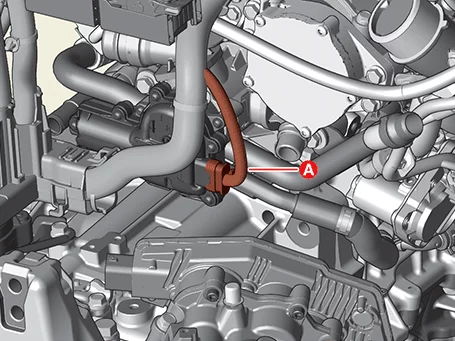
|
•
|
When disconnecting the Integrated Thermal Management Module (ITM) connector (A), make
sure the engine and all power are OFF.
|
|
•
|
Be careful not to apply static electricity or other voltage to the Integrated Thermal
Management Module (ITM).
|
|
•
|
Do not bring magnetic objects such as magnets close to the Integrated Thermal Management
Module (ITM).
|
|
|
| 9. |
Fill mixture of the antifreeze and water (45 - 60%) as much as possible through the reservoir tank inlet.
Coolant capacity : Approximately 7.0 â„“ (1.85 U.S gal,
7.396 U.S.qt., 6.15914 Imp.qt.)
|
|
•
|
Press the radiator upper/lower hoses to allow air to escape easily.
|
|
•
|
For best cooling performance, use a antifreeze that meets vehicle specifications.
Genuine antifreeze is an antifreeze whose quality and performance are guaranteed by Kia.
|
|
•
|
The coolant concentration should be kept at least 45-60% to prevent corrosion. If the
coolant concentration is less than 45-60%, there is a risk of corrosion and freezing.
|
|
•
|
It is not recommended if the concentration of the coolant exceeds 60%, as the cooling
effect may be reduced.
|
|
•
|
Do not mix different brands of antifreeze and coolant.
|
|
•
|
Do not add any anti-rust.
|
|
•
|
When mixing coolant and water, use distilled water instead of tap water.
|
|
|
| 11. |
Fill the reservoir tank with coolant.
|
20 minutes have passed since the engine start, check the coolant level in the reservoir tank and
replenish.
|
|
| 12. |
Connect the Integrated Thermal Management Module (ITM) connector after turning OFF the engine.
|
| 13. |
Repeat the engine ON/OFF and check the engine warning lamp OFF.
| (1)
|
Wait for 5 seconds with engine ON and then turn OFF the engine.
|
| (2)
|
Repeat the step (1) 3 times.
|
| (3)
|
Check the engine warning lamp OFF when engine is turned ON for the fourth time.
|
|
| 14. |
Run the engine until enough coolant circulates.
|
| 15. |
Check the Coolant capacity in the reservoir tank, refill it to the "MAX" (or "FULL") line.
|
| 16. |
Remove the air cleaner assembly.
(Refer to Intake and Exhaust System - "Air Cleaner")
|
| 17. |
Install the engine room under cover.
(Refer to Engine and Transaxle Assembly - "Engine Room Under
Cover")
|
Other information:
Kia Seltos SP2 (2021-2026) Service Manual: General Safety Information and Caution
Precautions when repairing the SRS
When repairing the SRS, pay attention to the following items.
If the items below are not observed, there is a possibility of serious injury due to unexpected airbag
deployment, and the airbag may not operate.
Kia Seltos SP2 (2021-2026) Service Manual: For safe AWD operation
WARNING
All Wheel Drive
Driving conditions that require All Wheel Drive place greater stress on the Kia Seltos than normal paved-road driving. When traveling on rough, slippery, muddy, snowy, or uneven surfaces, reduce your speed and be prepared for sudden changes in traction under the tires. If you are unsure whether the conditions are safe, stop the vehicle in a secure location and carefully decide the best way to continue.



