Contents:
Single-Use Parts
Non-reusable parts (Single-Use Parts)
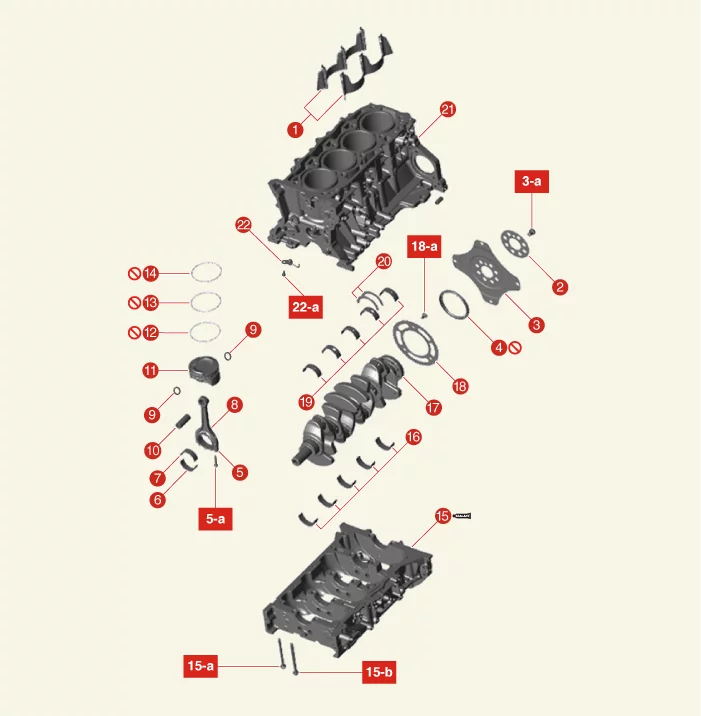
Workshop manual provides “Components and Components Location� which can be used to identify “Non-reusable parts�.
When repairing a vehicle, Non-reusable parts such as fasteners, gaskets, washers, clips and garnishes must be
replaced. Kia Non-reusable parts are designed to be installed only once.
Before working on a vehicle, check “Components and Components Location� to find the non-reusable parts in a
system.
※ Symbol of Non-reusable parts
Symbol
|
Meaning
|
|

|
Do not reuse the part. Replace with a new one.
|
※ Example of “Components and Components Location�
Tool Name / Number
|
Illustration
|
Description
|
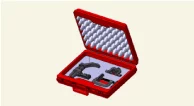
Lower arm ball joint remover
0K545 - A9100
|
|
Used for removal of front lower arm ball joint
|
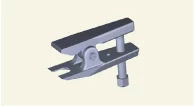
Ball joint puller
09568 - 1S100
|
|
Used for removal of tie rod end
|
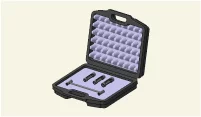
Shock absorber lock nut remover.
09546 - 3X100
|
|
Used for removal / installing of front strut / rear shock absorber lock nut
|
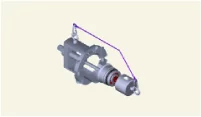
CTBA bushing remover & installer
09551 - AL100
|
|
Used for removal and installation of CTBA bushing
|
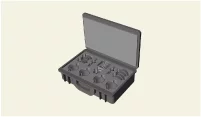
Lower arm 'G' bushing replacement tool
09545 - AL100
|
|
Used for replacement of the lower arm 'G' bushing
|
Troubleshooting
| Hard to turn steering wheel |
Suspected causes
|
Repair
|
Poor front wheel alignment
|
Adjust or repair
|
Over rotation resistance of lower arm ball joint
|
Replace
|
Over rotation resistance of strut bearing
|
Replace
|
Too low amount of tire air pressure
|
Adjustment
|
| Steering wheel recovery trouble |
Suspected causes
|
Repair
|
Poor front wheel alignment.
|
Adjust or repair
|
| Noise or poor ride comfort |
Suspected causes
|
Repair
|
Faulty wheel alignment
|
Adjust or repair
|
Inappropriated tire air pressure
|
Adjustment
|
Faulty function of shock absorber
|
Replace
|
Damaged coil spring
|
Replace
|
Damaged stabilizer
|
Replace
|
Damaged lower arm bushing
|
Replace
|
Loose stabilizer link securing nut
|
Retighten
|
Damaged stabilizer link (dust cover tearing, ring broke away)
|
Replace
|
Suspected causes
|
Repair
|
Faulty wheel alignment
|
Adjust or repair
|
Inappropriated tire air pressure
|
Adjustment
|
Suspected causes
|
Repair
|
Poor front wheel alignment.
|
Adjust or repair
|
Lower arm ball joint turning resistance is too small
|
Replace
|
Damaged lower arm bushing
|
Replace
|
| Vehicle pulls to one side |
Suspected causes
|
Repair
|
Faulty wheel alignment
|
Adjust or repair
|
Incorrect steering angle sensor zero point
|
Steering angle sensor zero-point calibration
|
Unbalance of right/left tire
|
Adjust or repair
|
Damaged or deformed lower arm
|
Replace
|
Damaged coil spring
|
Replace
|
Suspected causes
|
Repair
|
Poor front wheel alignment.
|
Adjust or repair
|
Poor wheel balance
|
Adjust or repair
|
Lower arm ball joint turning resistance is too much or too small
|
Replace
|
Damaged stabilizer
|
Replace
|
Damaged lower arm bushing
|
Replace
|
Faulty function of shock absorber
|
Replace
|
Poor coil spring
|
Replace
|
Under Body Parts Causing Abnormal Noise
Conditions for occurrence
|
Abnormal noise on uneven ground
|
Part
|
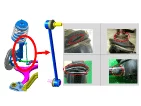
Stabilizer bar link
|
Stabilizer bar bushing
|
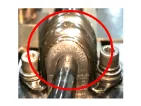
Lower arm ball joint
|
Strut insulator
|
Trouble area
|
|
|
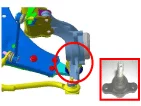
|
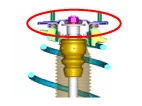
|
Type of abnormal noise
|
Rattling, Creaking noise
|
Squeaking noise
|
Clunking, Knocking noise
|
Clicking, Creaking noise
|
Occurring area
|
Under part
|
Under part
|
Under part
|
Upper part
|
Driving speed
|
20 - 40km/h (12.4 - 24.9 mph)
|
While low speed driving (20 - 40 km/h (12.4 - 24.9 mph))
|
20 - 40 km/h (12.4 - 24.9 mph)
|
-
|
Condition of road
|
Uneven road / bump
|
Uneven road / bump
|
Uneven road / bump
|
Uneven road / tough road
|
Cause
|
Loosen / leakage (teared down) / corrosion
|
Rolled down bumper rubber(tapping sound of bumper rubber upper part and insulator under part)
|
Loosen / leakage (teared down) / corrosion
|
Suspension tuning trouble(damping force, rubber characteristic)
|
Conditions for occurrence
|
Abnormal noise while going through uneven road / tough
road
|
Part
|
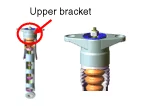
Strut / Shock absorber
|
Strut / Shock absorber
|
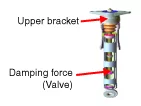
Shock absorber
|
Strut / Shock absorber
|
Trouble area
|
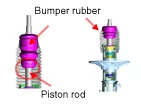
|
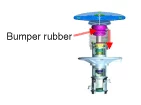
|
|
|
Type of abnormal noise
|
Rubbing noise
|
Clicking noise
|
Rubbing noise
|
Roaring noise
|
Occurring area
|
Upper part
|
Upper part
|
Upper part (rear)
|
Upper part (rear)
|
Driving speed
|
15 - 25 km/h (9.3 - 15.5 mph)
|
15 - 25 km/h (9.3 - 15.5 mph)
|
15 - 40 km/h (9.3 - 24.9 mph)
|
30 - 50 km/h (18.6 - 31.1 mph)
|
Condition of road
|
Uneven road
|
Uneven road
|
Uneven road and rough road
|
Rough road
|
Cause
|
Piston rod and bumper stopper inner fricative noise
|
Bumper stopper loosen
Striking noise at the bumper stopper upper and insulator lower part
|
Adhesion trouble of upper bracket rubber
|
Suspension tuning trouble
(damping force, rubber characteristic)
|
Conditions for occurrence
|
Abnormal noise on uneven ground
|
Abnormal noise while steering
|
Abnormal noise while driving
|
Part
|
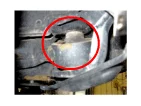
Lower arm 'G' bushing
|
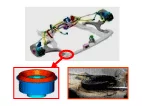
Crossmember bushing
|
Strut bearing
|
Wheel / Hub bearing
|
Trouble area
|
|
|
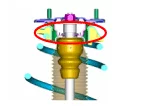
|
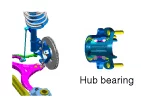
|
Type of abnormal noise
|
Rubbing noise
|
Clicking, Creaking noise
|
Clicking, Creaking noise
|
Roaring noise
|
Occurring area
|
Under part
|
Under part
|
Upper part
|
Lower and side part
|
Driving speed
|
10 - 40 km/h (6.2 - 24.9 mph)
|
-
|
-
|
20 - 60 km/h (12.4 - 37.3 mph)
|
Condition of road
|
Bump / rough road
|
Even road
|
Even road
|
Even road
|
Cause
|
Dropped off / fallen off
|
Dropped off / fallen off
|
Grease leakage
|
Damaged from outer impact, foreign substance inflow
|
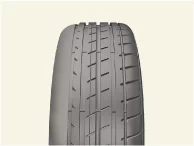
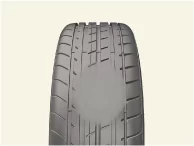
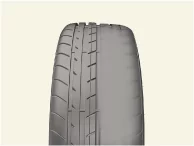
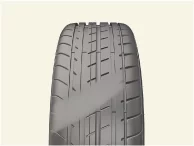
Wheel and tire diagnosis
|
Rapid wear at the center
|
Rapid wear at both shoulders
|
Wear at one shoulder
|
|
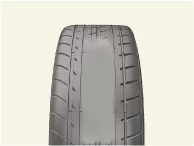
|
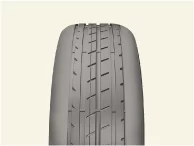
|
|
|
•
|
Poor installing of tire
|
|
•
|
Excessive toe on drive wheels
|
|
•
|
Excessive rapid acceleration
|
|
|
•
|
Poor installing of tire
|
|
•
|
Too low amount of tire air pressure
|
|
•
|
Damaged suspension components
|
|
•
|
Excessive cornering speeds
|
|
|
•
|
Too low amount of tire air pressure
|
|
•
|
Excessive toe on drive wheels
|
|
•
|
Camber out of specification
|
|
•
|
Damaged suspension components
|
|
Partial wear
|
Feathered edge
|
Diagonal wear
|
|
|
|
|
|
•
|
Damaged or worn brake discs
|
|
•
|
Excessive sudden acceleration and braking
|
|
•
|
Damaged suspension components
|
|
•
|
Too low amount of tire air pressure
|
|
|
•
|
Excessive toe on drive wheels
|
|
|
•
|
Excessive toe on drive wheels
|
|
•
|
Camber out of specification
|
|
•
|
Damaged suspension components
|
|
Other information:
Kia Seltos SP2 (2021-2026) Service Manual: Manual Speed Limit Assist (MSLA)
Speed Limit indicator
Set speed
Manual Speed Limit Assist allows the Kia Seltos driver to set a speed limit when they do not want the vehicle to exceed a specific speed.
If the vehicle speed goes above the preset limit, MSLA will operate. The set speed limit will blink and a warning chime will sound until the Kia Seltos returns to a speed within the selected limit.
Kia Seltos SP2 (2021-2026) Service Manual: AWD mode
AWD mode helps improve the driving performance of the Kia Seltos by controlling power delivery to all four wheels. This system supports better traction and stability when road conditions change, especially on wet, slippery, sandy, muddy, or uneven surfaces.
You can switch from AWD AUTO mode to AWD Lock mode by pressing the AWD Lock mode switch.


